Vinyl records for beginners come down to three choices: the size of the disc, the speed it spins at and how carefully it is handled.
Vinyl is one of the oldest ways independent artists reach listeners, and it ties into the wider world explained in what is an indie band.
How a vinyl record plays
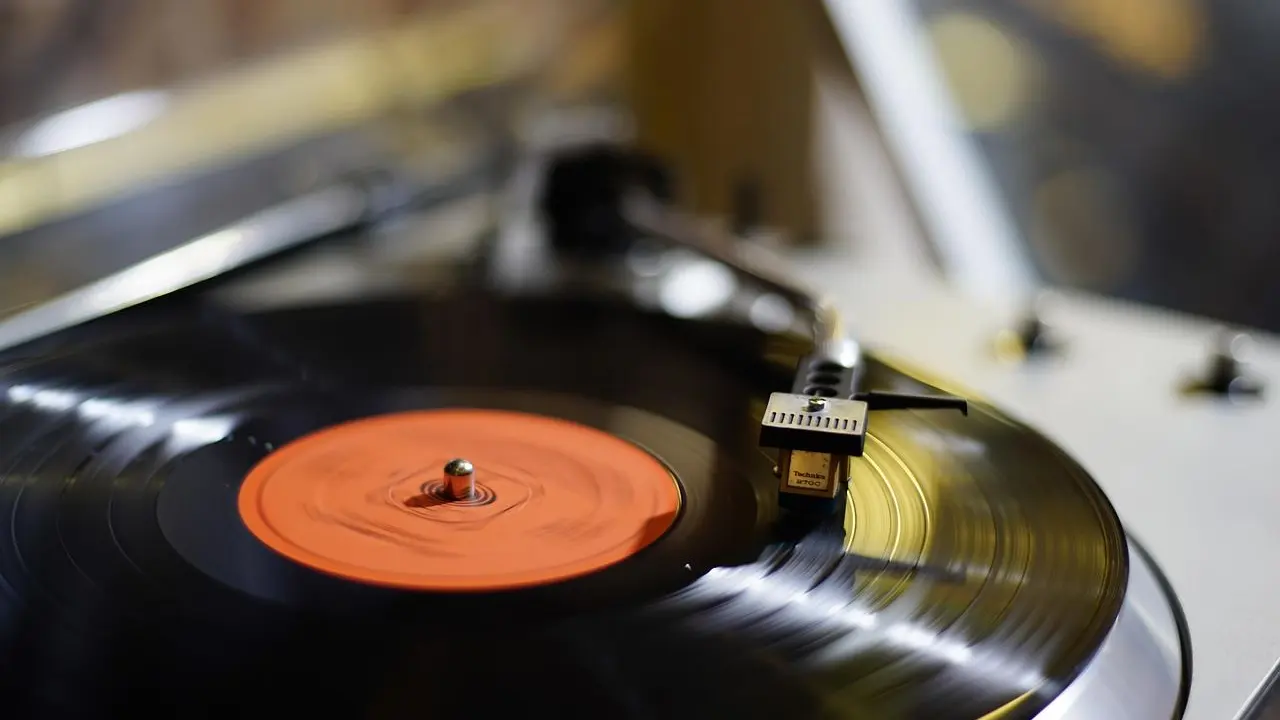
A record stores sound as a single spiral groove pressed into the surface of a disc. When the disc spins on a turntable, a tiny diamond or sapphire tip called a stylus rides in that groove. The wiggles in the groove walls make the stylus vibrate, and a cartridge turns those vibrations into a weak electrical signal.
That signal is too quiet for ordinary speakers, so it passes through a phono preamplifier first. Checking this before buying equipment avoids the most common beginner surprise, which is a record that plays but sounds faint and thin.
Records have a short history of format changes that still shapes what is on sale today. Early discs were brittle and held very little music, and the modern long-playing record arrived only after manufacturers learned to cut much finer grooves into a tougher material.
Sizes and speeds explained
Most turntable dials offer a choice of speeds, and each belongs to a particular era and disc size. The SFO Museum exhibition on the evolution of the record explains that the speed of early discs settled at 78 rpm, and that these ten-inch discs held nearly five minutes of music per side. The same exhibition notes that Columbia then introduced twelve-inch long-playing records that held far more music per side than a 78, and that RCA Victor introduced the smaller seven-inch, 45-rpm record the following year. The Spark Museum describes the Columbia release as spinning at 33 1/3 RPM.
| Format | Usual disc size | Speed | Typical use |
|---|---|---|---|
| Long-playing album (LP) | Twelve-inch | 33 1/3 rpm | Full albums |
| Single | Seven-inch | 45 rpm | One or two songs per side |
| Early disc | Ten-inch | 78 rpm | Older collections |
The sizes and speeds in the table follow the SFO Museum account of how the record evolved; the use column is a general guide.
In practice, most modern albums are twelve-inch discs at the long-playing speed, and smaller singles are cut for the faster speed. Playing a disc at the wrong speed makes the music sound too fast and high, or too slow and low, but it does not harm the record when corrected quickly.
Older ten-inch discs from the earliest era use different grooves and often need a differently shaped stylus, so beginners who find them at a market should treat them as a separate hobby rather than assume a standard turntable will suit them.
Handling a record safely
Most damage to a record comes from fingers and dust rather than from playing. The Library of Congress advises in its care and handling guidance for audio visual materials to wash and thoroughly dry hands first, to keep food and drink away, and to handle grooved discs by the edge and label areas only. The same page says to avoid touching the playing surface.
A few simple habits follow from that guidance:
- Hold the disc with the palms of the hands at the rim and the fingertips on the label.
- Slide the record out of its inner sleeve by lifting the sleeve edge slightly rather than dragging the disc across it.
- Return each record to its sleeve straight after playing instead of leaving it on the platter.
- Keep the stylus clean and replace it when the manufacturer recommends, because a worn tip wears the groove.
The Library of Congress page also says to allow materials from cool storage to acclimate to room temperature before playing back. A record carried in from a cold car or garage should sit for a while before it goes on the turntable.
Cleaning and storing records
For routine dust, the Library of Congress collections care page recommends canned air to blow away dust from vinyl records. Anything stickier, such as mould or residue, is a job for a preservation specialist or for guidance from a conservation organisation, not for improvised household liquids.
Storage matters just as much as cleaning. The same Library of Congress guidance says to store all formats upright, with discs on edge, and to store grooved discs on shelves with sturdy, immovable dividers that support the entire face of the disc in its sleeve. It also advises against storing grooved discs of different diameters together, so small singles belong in their own box apart from albums.
For home collections, the same guidance recommends a cool, relatively dry, clean and stable environment of about 35-40% relative humidity, and it warns against attics, basements and other places with a high risk of leaks and extremes. Heat is the main enemy: a record left in a sunny window or a parked car can warp, and a warped disc may never play cleanly again.
Replacing a worn paper inner sleeve with a softer, anti-static one is a cheap upgrade, and the same page notes that storage boxes should be made of acid-free paper stock and that containers which retain static charge are best avoided.
Starting a collection
New and used records both make sense for a beginner. Used records are usually cheaper and often turn up in local shops, markets and online listings, but their condition varies a great deal. Look at the surface under a bright light, check that the disc is flat and read any grading the seller gives. Scratches that catch a fingernail are likely to be audible.
Independent artists often press small runs of records as a way to fund a tour or an album, and records are a staple of the merchandise table at shows. The page on band merchandise basics explains how that side of the business works. Anyone curious about making music of their own can start with how to start an indie band, which covers members, rehearsal and first songs.
A sensible first collection grows slowly: start with a handful of albums that are loved already, play them often and learn what a clean pressing sounds like before chasing rare or expensive editions. Buying a record only because it is collectable is a quick way to end up with a shelf of discs that never get played.
Frequently asked questions
Do vinyl records wear out?
Show answer
Dirt, a worn stylus and rough handling cause far more damage than normal listening.
What speed should an album play at?
Show answer
Albums are made for the long-playing speed, which the Spark Museum gives as 33 1/3 RPM. Some larger records are cut for a faster speed, so check the label.
Can records be stored flat in a stack?
Show answer
Stacking puts weight on the discs at the bottom and can warp them. Store them upright, as the Library of Congress advises, with supports that carry the full face of each record.
Do I need a separate preamplifier?
Show answer
A turntable signal needs a phono stage to bring it up to normal listening level. Some turntables and amplifiers include one, and others require a separate unit, so check the specifications of the equipment before buying.